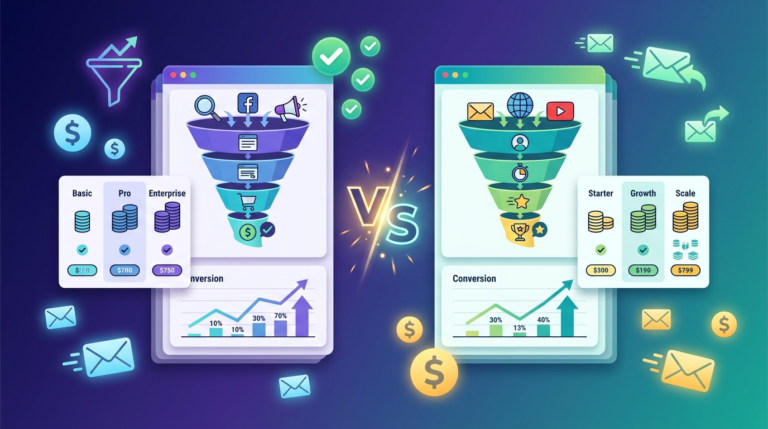
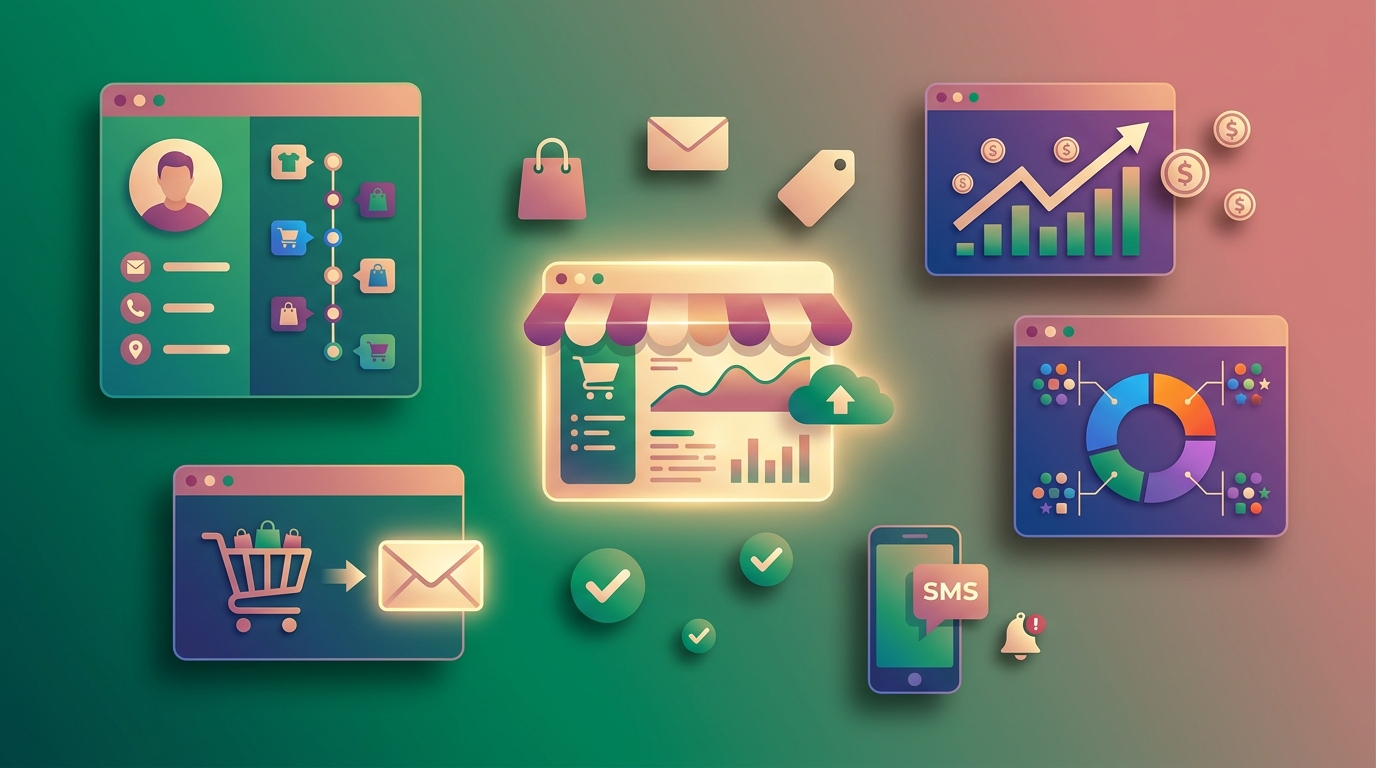

The best CRM for Shopify in 2026 is Klaviyo, a B2C customer platform with the deepest Shopify integration, predictive analytics and email and SMS automation built on your store data. Omnisend is the better value for smaller stores, HubSpot fits stores with a B2B or wholesale arm, ActiveCampaign leads on automation flexibility, and Gorgias covers the support side.
Here is the thing most guides skip: a typical Shopify store does not need a CRM in the traditional sense at all. Pipeline CRMs are built for sales teams working deals through stages. A DTC store has no deals, it has customers, orders and the job of bringing buyers back. What Shopify merchants actually need is a customer data and retention platform, which is why the tools that dominate this category, Klaviyo and Omnisend, are marketing automation platforms that call themselves CRMs. A classic pipeline CRM only earns its place when you have a B2B or wholesale component.
This guide compares the five platforms Shopify merchants actually shortlist in 2026, what each genuinely costs as your list grows, and a store-size framework for choosing, because as the agency team at Subjectlime notes from configuring both leaders on real clients, the right answer flips at around $500k in annual revenue. Pricing was checked in June 2026; confirm current figures on each vendor’s site.
What is the best CRM for Shopify?
Klaviyo is the best CRM for most Shopify stores because it turns store data into unified customer profiles with predictive analytics, and its Shopify integration is the deepest available, so much so that Shopify owns a stake in the company and recommends it for Shopify Plus merchants. Smaller stores watching budget are often better served by Omnisend.
The right pick depends on your store’s size and what kind of customer management you actually need:
Best Shopify CRM software compared
A side-by-side look at the five platforms. Prices were checked in June 2026 and all scale with contacts or usage, so confirm the current figure for your list size on each vendor’s site.
| Platform | Starting price | Type | Best for |
|---|---|---|---|
| Klaviyo | Free to 250 contacts, then ~$20 / mo | B2C customer platform | Most Shopify stores |
| Omnisend | Free plan, then ~$16 / mo | Email, SMS and push | Smaller stores on a budget |
| HubSpot | Free CRM core, paid hubs rise fast | Pipeline CRM suite | B2B or wholesale components |
| ActiveCampaign | From ~$15 / mo | Automation + CRM hybrid | Complex custom workflows |
| Gorgias | Scales with ticket volume | Helpdesk CRM | Customer support at scale |
The five platforms reviewed
Klaviyo is what a CRM looks like when it is designed for ecommerce rather than sales teams. It unifies email, SMS, web and mobile activity into a single customer profile, then layers on predictive analytics, customer lifetime value, churn risk and expected next order date, that feed straight back into segments and automations. Its Shopify integration is the deepest of any third-party tool, capturing granular behaviour down to product variants viewed, and the relationship runs deeper still: Shopify holds roughly an 11% stake in the company and names Klaviyo its recommended platform for Shopify Plus merchants. Over 193,000 businesses use it, including Glossier and Liquid Death.
The trade-offs are real and well documented. Pricing starts free for up to 250 contacts and around $20 a month at 500, but scales aggressively, reaching roughly $150 a month at 10,000 profiles and $400 at 25,000. The dashboard’s density rewards a dedicated email marketer and punishes a founder doing everything alone, and support on lower tiers is a recurring complaint in reviews. It is the strongest platform here, priced like it knows it.
- Deepest Shopify integration available
- Predictive analytics: CLV, churn, next order
- Most powerful segmentation and flow builder
- 350+ integrations, huge ecosystem
- Pricing compounds fast as your list grows
- Steep learning curve for small teams
- Support on lower tiers is a known frustration
Pick it if your store is growing past $500k a year and segmentation depth will pay for itself.
Skip it if you are a small store without a dedicated marketer, the depth will sit unused.
Visit KlaviyoOmnisend has built its business poaching Klaviyo customers on price, and the maths is straightforward: Sequenzy’s comparison puts it at $132 a month for 10,000 subscribers against Klaviyo’s $240, and across common list sizes it runs up to 35% cheaper at comparable feature levels. It covers the ecommerce essentials well, abandoned cart, welcome, post-purchase and win-back flows via genuinely useful pre-built templates, adds web push notifications neither rival offers the same way, and is consistently the most praised platform in its class for ease of use, with 24/7 support on all plans.
Two honest caveats. Its segmentation and reporting are shallower than Klaviyo’s, with no predictive analytics at all, and Talk Shop’s 2026 analysis flags a pricing change worth knowing: since May 4, 2026, SMS is only available on the Pro plan for new customers, so price your full email-plus-SMS stack rather than the headline. For a store under roughly $500k a year, though, most of Klaviyo’s advanced depth would go unused anyway, and Omnisend delivers the core for meaningfully less.
- Up to 35% cheaper than Klaviyo at scale
- Easiest to use, 24/7 support on all plans
- Pre-built ecommerce automation templates
- Web push notifications included
- No predictive analytics
- Shallower segmentation than Klaviyo
- SMS now Pro-plan only for new customers
Pick it if you are under ~$500k a year and want solid automation without the premium.
Skip it if predictive analytics and deep segmentation are central to your strategy.
Visit OmnisendHubSpot is the one genuine pipeline CRM on this list, and that is precisely its niche here. If your Shopify store has a B2B or wholesale arm, sales reps chasing bulk orders, distributor relationships, quotes moving through stages, then you have deals in the classic sense, and HubSpot’s free CRM core handles contacts, companies and pipelines properly, syncing Shopify customers, orders and abandoned carts natively. DataCops’ analysis is blunt and correct: a pure DTC store does not need this, but a hybrid store does.
The cost structure is the thing to understand. The free tier is genuinely free and genuinely useful, but the marketing muscle lives in paid hubs, and Marketing Hub Professional starts around $890 a month, six to seven times Omnisend’s cost at the same contact count. The sensible pattern for most hybrid stores: HubSpot free for the wholesale pipeline, Klaviyo or Omnisend for DTC retention.
- Free CRM core is genuinely useful
- Real pipelines, deals and lead scoring
- Native Shopify sync for customers and orders
- Scales to full marketing and service suite
- Marketing Hub Pro starts ~$890/mo
- Not ecommerce-specialised
- Overkill for pure DTC retention
Pick it if you have a wholesale or B2B arm with real deals to manage.
Skip it if you are pure DTC, a retention platform serves you better for less.
Visit HubSpotActiveCampaign occupies the space between marketing automation and CRM more deliberately than anything else here. Its automation builder is among the most flexible in the category, conditional logic, branching workflows and lead scoring against custom attributes, and its CRM and automation are tightly integrated, so pipeline actions trigger email sequences and vice versa. For a store with a genuinely unusual customer journey, subscriptions plus one-off products plus a service arm, say, that flexibility is the draw, at pricing that starts around $15 a month and stays more predictable than HubSpot’s.
The honest limits: its Shopify integration is not as native as Klaviyo’s or Omnisend’s for ecommerce objects, so product-level segmentation takes more manual configuration, and the learning curve is steeper than either. It is a power tool for operators who want control, not the fastest route to a working abandoned-cart flow.
- Most flexible automation builder here
- CRM and automation tightly integrated
- Lead scoring on custom attributes
- Predictable pricing vs HubSpot
- Less native Shopify integration
- Product-level segmentation takes setup
- Steeper learning curve
Pick it if your customer journey is unusual and you want full workflow control.
Skip it if you want ecommerce flows working out of the box this week.
Visit ActiveCampaignGorgias covers the side of customer relationships the marketing platforms ignore: support. It is a helpdesk built specifically for Shopify, pulling order data directly into every ticket so agents can see, refund, duplicate or modify orders without leaving the conversation, across email, chat, social and SMS. DataCops’ store-size analysis notes it scales cleanly with Shopify order volume, which is exactly when support tickets start eating a founder’s week, typically from around $500k in annual revenue.
Be clear on what it is: a support CRM, not a marketing one. It does not send campaigns or run abandoned-cart flows, so it complements Klaviyo or Omnisend rather than replacing them. Pricing scales with ticket volume, so model it against your actual support load.
- Shopify order data inside every ticket
- Refund and edit orders from the helpdesk
- Email, chat, social and SMS in one inbox
- Scales with order volume
- Support only, no marketing automation
- Needs pairing with a retention platform
- Ticket-based pricing needs modelling
Pick it if support volume is climbing and agents keep tab-switching into Shopify.
Skip it if you get a handful of tickets a week, email is fine for now.
Visit GorgiasWhich Shopify CRM fits your store size?
Under $500k in annual revenue, choose Omnisend or Klaviyo’s free and starter tiers. From $500k to $2M, Klaviyo’s paid tiers earn their cost, with Gorgias added if support volume justifies it. Above $2M, Klaviyo’s depth compounds, and HubSpot or Salesforce enter only for B2B components. Match the tool to your revenue, not your ambitions.
Store size is the honest decision axis, because the leaders’ capabilities only pay off at certain volumes. Under $500k, the analysis from both DataCops and Subjectlime agrees: Klaviyo’s advanced segmentation is not fully exploitable, and most stores at this size will not use 80% of its features, which makes Omnisend’s lower price the rational pick. The two platforms’ deliverability is comparable when DNS is configured properly, so you are not sacrificing inbox placement by choosing the cheaper one.
The flip happens as revenue grows. Above $500k, Subjectlime’s client data shows the depth starts producing compounding returns, with well-executed migrations typically lifting total email revenue 18 to 28% within 90 days, and above $1M the Klaviyo-vs-Omnisend revenue gap typically runs 15 to 25% in Klaviyo’s favour. That is when the premium stops being a cost and starts being margin. Either direction of migration is common and valid: upgrading into Klaviyo’s depth when revenue justifies it, or downshifting to Omnisend to cut costs when it does not.
What features matter most in a Shopify CRM?
The features that matter most are deep native Shopify sync for customers, orders and abandoned carts, prebuilt ecommerce automation flows, behavioural segmentation, email and SMS from one platform, and revenue attribution per flow. A pipeline and lead scoring only matter if you sell B2B or wholesale.
Use this as your trial checklist:
Native Shopify sync, not a Zapier bridge
Customers, orders, products and abandoned checkouts should flow in through a one-click app install. The depth of that sync determines what your segments can see, and it is where Klaviyo and Omnisend beat the generic tools.
The core four flows, prebuilt
Welcome, abandoned cart, post-purchase and win-back generate most ecommerce email revenue and run around the clock. Templates that ship ready to customise, Omnisend’s speciality, get you earning in days rather than weeks.
Behavioural segmentation
Segments built from what customers actually did, products viewed, order value, time since purchase, beat demographic lists every time. The deeper the query logic, the more precise the targeting, which is the heart of Klaviyo’s premium.
Email and SMS in one place
Coordinating the two channels from one platform prevents the double-messaging that gets you unsubscribed. Check how SMS is priced: bundled, credit-based or per-message models behave very differently at volume.
Revenue attribution per flow
You should be able to see exactly what each automation earns. That number is how you justify the subscription, and it is what separates a retention platform from a glorified newsletter tool.
How much does a CRM for Shopify cost?
A Shopify CRM typically costs $16 to $150 a month for most stores in 2026, scaling with contact count. Omnisend starts around $16 a month at 500 contacts and $132 at 10,000, Klaviyo around $20 and $150 to $240 at the same sizes, while HubSpot’s marketing tiers start near $890 a month.
Contact-based pricing is the whole game here, so model the cost at your list size a year from now, not today. Two nuances matter. First, the platforms count differently: Klaviyo bills on active profiles you can target while Omnisend bills on billable contacts, so a list heavy with lapsed subscribers changes the comparison. Second, SMS pricing diverged in 2026: Omnisend moved SMS to its Pro plan for new customers with per-message pricing from $0.007, while Klaviyo sells SMS credits as an add-on, so price the full email-plus-SMS stack you will actually run.
All five platforms offer free plans or trials, so the cheapest research is a real one: connect your store, import a segment, run one abandoned-cart flow for two weeks and read the revenue number. Prices here were checked in June 2026 and move often, so confirm current figures on each vendor’s pricing page.
Which should you choose?
For most Shopify stores, Klaviyo is the best CRM in 2026. Its store-data-driven customer profiles, predictive analytics and the deepest Shopify integration available make it the platform your retention revenue grows into, which is exactly why Shopify itself recommends it.
Choose Omnisend if you are under roughly $500k a year, it delivers most of the result at up to 35% less, and you can migrate up later. Choose HubSpot only for a genuine B2B or wholesale pipeline, ideally its free tier alongside a retention platform. Choose ActiveCampaign if your customer journey is unusual enough to need its workflow flexibility. And add Gorgias when support tickets start eating your week.
Whichever you shortlist, run the same test: connect the store, launch one abandoned-cart flow, and compare the revenue it attributes after two weeks. The platform that earns on your actual traffic is the right one.
Frequently asked questions
Shopify includes basic customer profiles with order history, tags and segments, but it is not a full CRM. There is no marketing automation, predictive analytics or pipeline management built in, which is why most merchants add a platform like Klaviyo or Omnisend through the Shopify App Store for retention marketing.
Klaviyo positions itself as a B2C CRM, and for ecommerce purposes it functions as one: it unifies email, SMS, web and mobile data into single customer profiles with predictive analytics. It is not a pipeline CRM for sales teams, so businesses with B2B deals still pair it with a tool like HubSpot.
HubSpot’s free CRM is the best genuinely free option for contact and pipeline management with native Shopify sync. For retention marketing, Klaviyo is free up to 250 contacts and Omnisend’s free plan covers 250 contacts with 500 emails a month, both enough to test core flows before paying.
Klaviyo is better for stores above roughly $500k in annual revenue that will use its deeper segmentation and predictive analytics, while Omnisend is better value below that, running up to 35% cheaper at comparable list sizes with easier setup. Both integrate deeply with Shopify and their deliverability is comparable when configured properly.
Most Shopify stores pay $16 to $150 a month in 2026 depending on list size. Omnisend runs about $16 at 500 contacts and $132 at 10,000, Klaviyo about $20 and $150 to $240 at the same sizes, and HubSpot’s Marketing Hub Professional starts around $890 a month for hybrid B2B stores.
They solve different halves of the customer relationship. A retention platform like Klaviyo or Omnisend drives repeat purchases, while a helpdesk like Gorgias manages support with Shopify order data inside every ticket. Small stores can start with just the retention platform and add a helpdesk once ticket volume grows, typically around $500k in annual revenue.
- Omnisend, “Klaviyo Review 2026: Features, Pricing and Verdict” and “Omnisend vs Klaviyo,” omnisend.com, 2026.
- Sequenzy, “Klaviyo vs Omnisend: Which Is Better in 2026?” and “Omnisend vs HubSpot (2026),” sequenzy.com, 2026.
- Talk Shop, “Klaviyo vs Omnisend 2026: Pricing & Features Compared,” letstalkshop.com, 2026.
- Subjectlime (Klaviyo Platinum Partner), “Klaviyo vs Omnisend: Which One for Shopify in 2026?,” subjectlime.com, 2026.
- DataCops, “Best CRM for Shopify Stores” and “Best CRM Integration for Shopify 2026,” joindatacops.com, 2026.
- Vendor pricing pages for Klaviyo, Omnisend, HubSpot, ActiveCampaign and Gorgias, accessed June 2026.