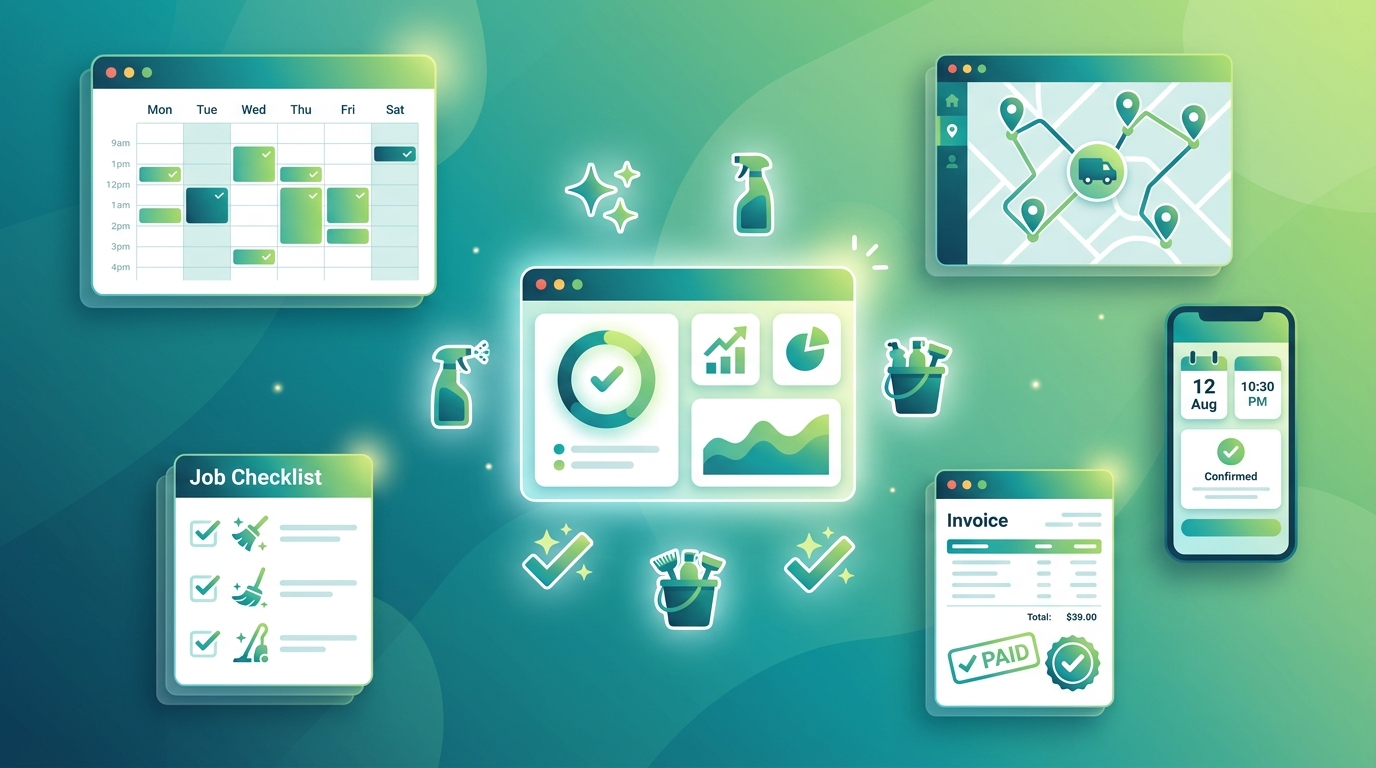

The best CRM for a cleaning business in 2026 is Jobber, an all-in-one field service platform covering quoting, scheduling, invoicing and client management. ZenMaid is the strongest pick for residential maid services, Swept is built for commercial janitorial teams, Housecall Pro leads on client communication, and Connecteam is the budget option with a free plan.
The economics of a cleaning business decide what its CRM needs to do. A one-time clean is worth roughly $150 to $300. A biweekly recurring client is worth $3,600 to $7,800 a year. So the job of your software is not just storing contacts, it is converting one-off customers into recurring contracts and making sure none of those recurring visits slip. A generic sales CRM was never built for that, which is why the best tools for cleaning companies are field service platforms with CRM, scheduling and invoicing fused together.
This guide compares the five platforms cleaning businesses actually shortlist in 2026, what each genuinely costs once you get past the headline price, and how to choose between them based on whether you run residential recurring cleans, commercial janitorial contracts, or a mix of both.
What is the best CRM for a cleaning business?
Jobber is the best CRM for most cleaning businesses because it combines quoting, recurring scheduling, invoicing, payments and a client hub in one polished platform. Residential-only maid services often prefer ZenMaid, while commercial janitorial operators managing multiple buildings are better served by Swept.
The right pick depends on the kind of cleaning work you do:
Best cleaning business CRM software compared
A side-by-side look at the five platforms. Prices were checked in June 2026 and most scale with users or plan depth, so confirm the current figure for your team size on each vendor’s site.
| Platform | Starting price | Core focus | Best for |
|---|---|---|---|
| Jobber | From $29 / mo (1 user) | All-in-one field service | Most cleaning businesses |
| ZenMaid | From ~$19 / mo | Residential maid services | Recurring home cleaning |
| Housecall Pro | From ~$59–$79 / mo | Client communication | Customer-facing polish |
| Swept | Plan and location based | Janitorial operations | Commercial cleaning teams |
| Connecteam | Free up to 10 users, then $29 / mo | Team management | Budget-conscious crews |
Jobber is the most polished field service platform on the market, and for a cleaning business it covers the whole job cycle: request, quote, recurring schedule, job, invoice, payment. The client hub lets customers approve quotes, check appointment details and pay invoices themselves, which cuts the admin chasing that eats an owner’s week. It integrates cleanly with QuickBooks Online, and its mobile app is one the crews will actually use.
Know the pricing structure before you commit. The advertised $29 entry plan is for a single user, so a company with even a small crew lands on Core at around $79 or Connect at around $169 a month for up to five users. GPS tracking and the deeper automation also sit in the higher tiers. It is generic field service software too, so there are no janitorial inspection checklists or square-footage bidding tools, just well-built general forms.
- Full cycle: quote, schedule, invoice, payment
- Client hub for self-serve approvals and payments
- Excellent mobile app and QuickBooks sync
- Award-winning support and fast onboarding
- $29 entry plan is single-user only
- GPS and automation sit in higher tiers
- No cleaning-specific bidding or inspections
Pick it if you want one reliable platform to run quoting, scheduling and payments end to end.
Skip it if you are a solo cleaner on a tight budget or need janitorial-specific tooling.
Visit JobberZenMaid is built for one business model: recurring home cleaning. The scheduling view is designed around repeating jobs rather than one-off projects, rebooking prompts fire automatically, and digital room-by-room checklists standardise what cleaners do in each home. Its reporting tells you which cleaners are productive and which clients are actually profitable, which is exactly the insight a maid service owner needs.
Two honest caveats. SMS is not included: appointment texts are billed separately at around $14 per 125 messages, which adds up fast if you remind 50 clients twice a week, so factor it into any comparison. And the structure that makes ZenMaid great for straightforward recurring cleans can feel rigid for mixed work like deep cleans, move-outs and post-construction jobs.
- Purpose-built for recurring maid scheduling
- Automatic rebooking prompts protect revenue
- Room-by-room digital checklists
- Cheap entry point, from around $19 a month
- SMS billed separately, ~$14 per 125 texts
- Rigid for mixed or one-off job types
- Residential only, not built for janitorial
Pick it if your business is weekly and biweekly home cleans and you want software shaped exactly to that.
Skip it if you do commercial contracts or a wide mix of one-off job types.
Visit ZenMaidHousecall Pro’s strength is the customer-facing side. Automated appointment messaging, online self-booking, on-my-way texts, instant invoicing and review requests all come standard, which makes a small cleaning company feel like a big professional operation to its clients. The live dispatch map and in-app team chat keep crews coordinated, and its scheduling board genuinely shines for operators dispatching multiple teams.
The pricing reality needs reading carefully. The Basic plan sits around $59 to $79 a month, but QuickBooks integration, GPS tracking and time tracking, the features that justify Housecall Pro over a cheaper tool, only arrive on the Essentials plan at roughly $189 a month. For most cleaning businesses, that is the real entry price. Backend depth like reporting and CRM detail is also lighter than some rivals.
- Best-in-class automated client messaging
- Online booking and review management built in
- Live dispatch map and team chat
- Polished, professional client experience
- QuickBooks and GPS need the ~$189 Essentials tier
- Backend reporting lighter than rivals
- Overkill for a solo cleaner with a small round
Pick it if winning and impressing clients is your priority and you dispatch multiple crews.
Skip it if the features you need all sit in the Essentials tier and the budget does not stretch.
Visit Housecall ProSwept is the specialist for the other half of the industry: commercial janitorial companies cleaning offices, buildings and multi-site contracts. It focuses on site operations, scheduling crews across locations, two-way messaging with custom channels per crew, location-based time tracking that clocks cleaners in automatically when they arrive on site, inspections, and even cleaning supply tracking from the mobile app. Its mood reporting surveys cleaners after jobs, a smart touch in an industry where staff turnover kills contracts.
The trade-off is scope. Swept does not do quoting, invoicing or payments, so it is not a complete business system the way Jobber is. Commercial operators typically pair it with accounting software. Pricing is by plan and number of locations rather than a simple per-user fee, so get a quote for your actual site count.
- Built specifically for janitorial site work
- Location-based automatic time tracking
- Crew messaging and inspection workflows
- Supply tracking from the mobile app
- No quoting, invoicing or payments
- Needs pairing with accounting software
- Pricing varies by plan and locations
Pick it if you run commercial janitorial crews across multiple buildings.
Skip it if you need quoting and invoicing in the same tool.
Visit SweptConnecteam is not a classic CRM, it is a team management app, but for a small cleaning company the overlap is bigger than you would think. Scheduling, time tracking, task checklists, team chat and forms cover the operational core of running crews, and the Small Business Plan is genuinely free for up to 10 users. Paid plans start at $29 a month covering up to 30 users, which is a different pricing logic from the per-user models elsewhere on this list and very kind to growing teams.
What it lacks is the client side: there is no quoting, no client hub, no invoicing pipeline aimed at customers. It manages your workforce, not your sales. For a startup cleaning business, Connecteam free plus simple invoicing elsewhere is a perfectly sensible stack until volume justifies an all-in-one.
- Completely free for up to 10 users
- Flat pricing covers up to 30 users on paid plans
- Strong scheduling, checklists and team chat
- Easy for any crew member to use
- Not a true CRM, no client management depth
- No quoting or client-facing invoicing flow
- You will outgrow it as client volume rises
Pick it if you are starting out, watching every dollar, and mainly need to organise your crew.
Skip it if you need quoting, a client hub and payments in one system.
Visit ConnecteamResidential or commercial cleaning: does it change which CRM you need?
Yes. Residential cleaning businesses need recurring appointment scheduling, rebooking automation and client reminders, which suits ZenMaid or Jobber. Commercial janitorial companies need multi-site crew scheduling, inspections and location-based time tracking, which suits Swept. The two models stress completely different parts of the software.
Residential cleaning lives and dies on the recurring calendar. The software’s job is to keep weekly and biweekly slots filled, prompt rebooking before a gap appears, and remind homeowners so crews are not locked out of empty houses. Client communication and easy card payment matter because you are dealing with dozens of individual households.
Commercial janitorial is a different game. Contracts are bigger and longer, work happens out of hours across multiple buildings, and the risks are no-shows, missed areas and failed inspections. The software’s job is proving the work happened: location-verified clock-ins, area checklists, inspection scores and supply levels. A residential scheduler does none of that well, and a janitorial ops tool is wasted on a maid round. Pick the tool for the half of the industry you are actually in, and if you straddle both, Jobber is the most credible single compromise.
What features matter most in a cleaning business CRM?
The features that matter most are recurring job scheduling, automated reminders and rebooking, quoting and invoicing, mobile apps crews will actually use, payment collection, and conversion tracking from one-off cleans to recurring contracts. Commercial operators should add inspections and location-based time tracking.
Use this as your trial checklist:
Recurring scheduling that cannot drop a visit
Repeating jobs are your revenue. The calendar must handle weekly, biweekly and monthly patterns natively, with changes to one visit not breaking the series.
Automated reminders and rebooking
Reminder texts cut no-access visits, and automatic rebooking prompts are what turn a one-time deep clean into a $4,000-a-year recurring client. This automation pays for the software on its own.
Quoting, invoicing and payment in one flow
The faster a quote becomes a booked job and a paid invoice, the better your cash flow. Look for client self-serve approval and card payment without chasing.
A mobile app crews will actually use
Your cleaners live on their phones, not at desks. Job details, checklists, photos and clock-in need to work flawlessly on a phone over patchy signal.
Proof of work for commercial contracts
For janitorial work, location-verified time tracking, photo documentation and inspection checklists are what win contract renewals, because they prove the clean happened.
How much does a CRM for a cleaning business cost?
A cleaning business CRM typically costs between $19 and $200 a month in 2026. Solo cleaners can start around $19 to $29, small crews should budget $79 to $189 a month for the tiers with GPS, QuickBooks and automation, and free options like Connecteam exist for basic team management.
The headline prices in this category are honest about almost nothing, so check three things. First, user limits: Jobber’s $29 plan is one user, and a three-person crew needs a higher tier. Second, feature gating: on Housecall Pro the GPS, time tracking and QuickBooks sync that most businesses actually want sit in the roughly $189 Essentials tier, not the advertised entry plan. Third, usage fees: ZenMaid bills SMS separately, and payment processing carries card fees on every platform.
Budget against the tier you will really use, not the cheapest one on the pricing page. Prices here were checked in June 2026 and move often, so confirm current figures on each vendor’s site before committing.
Is there a free CRM for cleaning businesses?
Connecteam is free for up to 10 users and covers scheduling, time tracking and team chat, making it the best genuinely free option for cleaning crews. General CRMs like Zoho offer free tiers for up to 3 users, but no free tool includes the quoting, recurring billing and client hub features cleaning businesses eventually need.
Free works at the start. A solo cleaner or a two-person team can run on Connecteam’s free plan plus simple invoicing and lose nothing. The ceiling arrives with growth: once you are quoting daily, juggling dozens of recurring clients and chasing payments, the missing client-side features cost you more in admin hours and lost rebookings than a $79 subscription would. Every paid platform on this list offers a free trial, so the smarter route is testing the real tools with a week of genuine jobs rather than squeezing a free tier past its design.
Which should you choose?
For most cleaning businesses, Jobber is the best CRM in 2026. It runs the entire job cycle from quote to payment in one polished platform, the client hub genuinely reduces admin, and it scales from a small crew to a multi-team operation without changing systems.
Choose ZenMaid if you run a residential recurring maid service and want software shaped to exactly that. Choose Housecall Pro if client experience and multi-crew dispatch are your edge and the Essentials tier fits the budget. Choose Swept if you are commercial janitorial and need site operations and inspections. And start with Connecteam free if you are early-stage and the priority is simply organising your crew.
Whichever you shortlist, run one real week of jobs through the trial: a quote, a recurring schedule, a reschedule, an invoice and a payment. The platform that handles your worst Tuesday is the right one.
Frequently asked questions
For a small cleaning business, Jobber is the strongest all-round choice because it handles quoting, recurring scheduling, invoicing and payments in one platform. A solo residential cleaner on a budget can start with ZenMaid from around $19 a month, and a small crew can manage operations free on Connecteam for up to 10 users.
Jobber is better for most cleaning companies because its core plans include more of the essentials and its workflow from quote to payment is more complete. Housecall Pro leads on automated client messaging and dispatching multiple crews, but its key features like GPS and QuickBooks sync require the roughly $189 a month Essentials tier.
Commercial janitorial companies typically use Swept, which is purpose-built for multi-site cleaning operations with crew scheduling, location-based time tracking, inspections and supply management. Because Swept does not handle quoting or invoicing, operators usually pair it with accounting software like QuickBooks.
You can, but it will not handle the work that matters. Generic CRMs manage contacts and pipelines, but lack recurring job scheduling, crew dispatch, route planning and field invoicing. A field service platform like Jobber or a cleaning specialist like ZenMaid covers both client management and operations in one tool.
Cleaning business software typically costs between $19 and $200 a month in 2026. Entry plans start around $19 to $29 but often limit users, while the tiers most small crews actually need run $79 to $189 a month. Watch for extras like SMS bundles and payment processing fees on top of the subscription.
Prioritise recurring job scheduling, automated reminders and rebooking prompts, quoting and invoicing in one flow, a reliable mobile app for crews, and card payment collection. Commercial janitorial businesses should add location-based time tracking, inspection checklists and photo proof of work to that list.